Understanding what Meta Ad Buying :
Before understanding what Auction and Reservation are, let us first get a quick idea of what Meta Ad Buying means.
When you’re setting up a Facebook (Meta) ad campaign, the first thing you’ll notice under the campaign settings is an option called “Buying Type.”
Have you ever spotted that and wondered:
- What does it mean?
- What does it even do?
- Why is it important?
- How does it affect your ad campaign?
Well, this option decides how you will pay for your ads and how Meta will deliver them.
In simple words, Meta gives you different ways to buy ad space, and these are known as “Buying Types.”
Meta Update: Changes to Ad Buying Model:
In November 2023, Meta made an important change to its ad buying model to offer more flexibility when building campaigns.
The previous “Reach & Frequency” buying option has been removed (or more accurately, replaced) with a new and simplified feature called “Reservation.”
This update helps advertisers plan campaigns with more control and predictability, especially for brand-focused objectives.
Understanding Meta Ad Buying Types:
Let’s now understand the types of Ad Buying available on Meta Ads.
Ad buying types play a huge role in how your ad inventory is purchased – meaning, how your ads are delivered and how much they cost. In fact, 99% of advertisers commonly use the Auction buying type.
Facebook has two buying models till Oct 2023:
- Auction
- Reach and Frequency
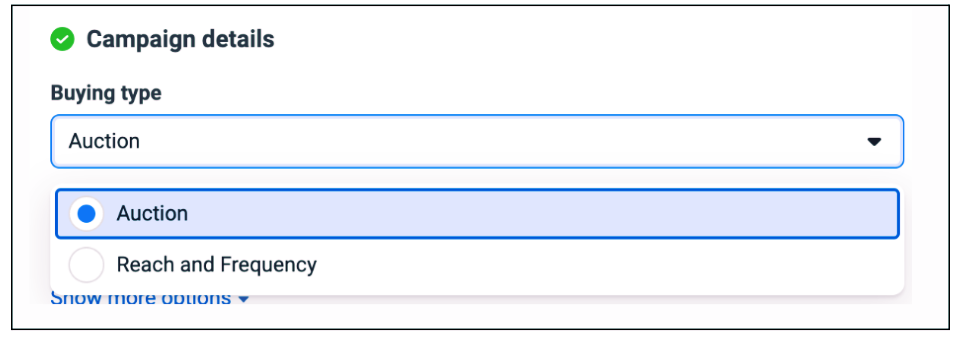
Old Buying Model
Facebook offers two primary buying models after Oct 2023
- Auction Buying
- Reservation
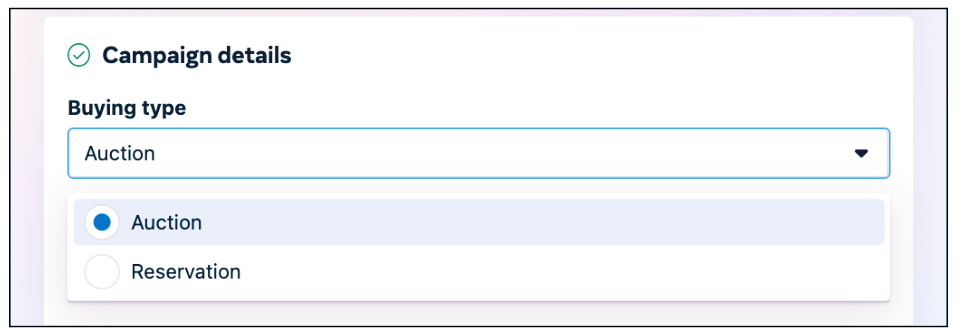
New Buying Model
Let’s break down what each of them means and when to choose and use the right one based on your campaign goals:
1. Auction Buying ( Real Time Bidding Model )
Auction-based buying is the default option for most Facebook (Meta) ad campaigns.
In this model, you’re competing with other advertisers in real-time to show your ad to the same audience. Meta runs an “Auction” behind the scenes to determine which ad gets shown.
Meta’s algorithm determines the winner based on a mix of bid amount, estimated action rates ( how likely people are to engage), and ad quality and relevance.
Let’s see how the Auction Buying model works:
Let’s say you’re running an ad for your mobile game, targeting females aged 18–24 in India. At the same time, other advertisers (maybe another game or a brand) are targeting that same audience.
👉 Meta decides which ad gets shown based on 3 key factors:
Meta Auction Winning Factors:
- Bid: How much are you willing to pay (manual or automatic bidding)
- Estimated Action Rate: How likely users are to click, install, or take action.
- Ad Quality & Relevance: Based on user feedback, engagement, and experience.
Even if your bid is lower, you can still win the auction if your ad is more relevant or has higher quality.
Meta Auction Formula:
Here you see two typesof auction formulas:
The updated and latest formula is :
( Total Auction Value = Advertiser Bid × Estimated Action Rate + User Value / Ad Quality )
(or)
( Highest Total Value = Advertiser Bid x Estimated Action Rate x Ad Quality )
Meta chooses the ad with the highest total value, not just the highest bid.
So, it rewards ads that are not just expensive, but also engaging, useful and well-targeted.
Key Features of Auction Buying Model:
✅ Competitive & Cost-Effective: Ads compete in a bidding system, making it more flexible and budget-friendly.
✅ Dynamic Pricing:The cost depends on factors like demand, competition for your audience, and ad relevance.
✅ Real-Time Optimization: Facebook’s system continuously optimizes delivery based on performance.
✅ Performance-based campaigns (e.g., app installs, lead generation, website conversions)
✅ Businesses looking for budget flexibility and customizable bidding strategies
✅ Advertisers of all sizes: from startups to large brands – aiming for scalable, measurable results
2. Reservation Buying (Fixed Cost or Reach & Frequency Buying)
Reservation Buying is also known as Fixed Cost, previously Reach and Frequency buying.
In reservation buying, advertisers purchase or book ad placements at a fixed price or cost in advance.
This model guarantees impressions and reach, making it ideal for campaigns where predictability and visibility are the priority.
Reservation ads can appear on the Facebook Feed, including in-stream videos, as well as the Instagram feed and Explore.
Let’s see how the Reservation Buying model works:
- Who do you want to reach
- How many times have they seen the ad
- How long will the campaign run
- How much do you pay per 1,000 impressions (CPM)
Let us say:
- You select your audience, campaign duration, frequency (how often people see the ad), and number of impressions
- Facebook locks in your ad delivery
- You pay a fixed CPM (Cost per 1,000 impressions)
👉 No auction, no surprises, just guaranteed delivery at a set cost.
Key Features of the Reservation Buying Model:
✅ Guaranteed Delivery: Your ads are shown to the selected audience at a guaranteed price.
✅ Predictable Costs: No bidding, you pay a fixed, predetermined amount.
✅ Brand awareness campaigns: where consistent reach and visibilityare.
✅ Large advertisers with big budgets are looking for a secure and stablead placement.
✅ Event-based promotions where guaranteed exposure is needed (e.g., product launches, special event campaigns).
✅ Frequency: You can manage or have control over how often people can see your ad.
What is the difference between Auction and Reservation?
✅ Auction allows advertisers to compete in real-time for ad placements. This can lead to variable costs and unpredictable delivery depending on competition.
✅ Reservation offers predictable pricing and delivery. It allows advertisers to plan campaigns in advance with certainty and control.
Comparison between Auction & Reservation Ad Buying:

Which one should you choose? Here’s a simple thumb rule 👍
✅ If you’re running a performance-driven campaign with a limited budget and looking for cost-effective conversions, choose Auction
✅ If you’re focused on brand awareness with a guaranteed reach and have a fixed budget, choose Reservation

Tips for Game Publishers:
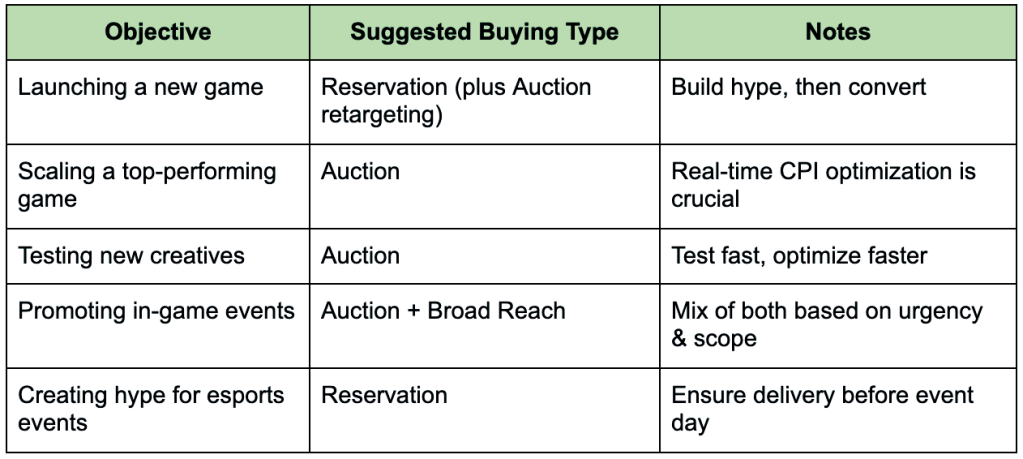
When should you use Auction and Reservation Ad Buying Models?
✅ Use Auction when:
- You need flexibility
- You’re comfortable with variable costs
- You’re running short-term or performance-based campaigns
- You want to target specific, competitive audiences
✅ Use Reservation when:
- You want predictable results
- You’re planning a long-term brand awareness campaign
- Consistency and guaranteed reach are more important than performance
Changing the Ad Buying type after publishing the Meta Ad campaign:
Can you switch between Buying types during a campaign that is published or live?
👉 The answer is NO, once your campaign is live, you cannot change the Buying Type.
You must select either Auction or Reservation at the time of campaign setup, and that choice remains fixed for the entire duration of the campaign.
Final Thoughts:
Both Auction and Reservationbuying models have their place in your strategy.
👉 Auction is your best bet if you’re starting or running performance campaigns with flexible budgets.
👉 If you’re launching a new product or aiming for maximum eyeballs during a specific time window, Reservationgives you more control
👉 In the gaming world, where user acquisition, branding, and retention are key, understanding when and how to use each model can make or break your campaign’s success.


Stay up to date
Latest Posts

Unlocking tomorrow’s hits today: Trend insights , market research and ideation services for game studios.