Supercell isn’t announcing a new Barbarian, an engine upgrade, or a flashy feature. Instead, it’s making a quieter but far more important move: re-architecting how a live-game company operates at scale without breaking what made it special.
At a glance, CEO Ilkka Paananen’s recent message may sound familiar. Team autonomy remains sacred. Leadership still avoids top-down control. Great games should last for years. But beneath that consistency is a sharper organizational shift that reflects where elite mobile studios are heading next.
Autonomy Wasn’t Abandoned — It Was Protected
Supercell’s defining principle has always been its independent teams, or “cells.” That hasn’t changed. What has changed is how the company supports those teams once games succeed at massive scale.
Leadership isn’t stepping in to manage roadmaps or creative direction. Instead, it’s doubling down on its original role: building the environment that allows teams to operate independently for a decade or more. Responsibility and ownership aren’t just encouraged — they remain non-negotiable.
The Data Explains the Decision
Supercell’s 2025 performance makes the logic hard to ignore.
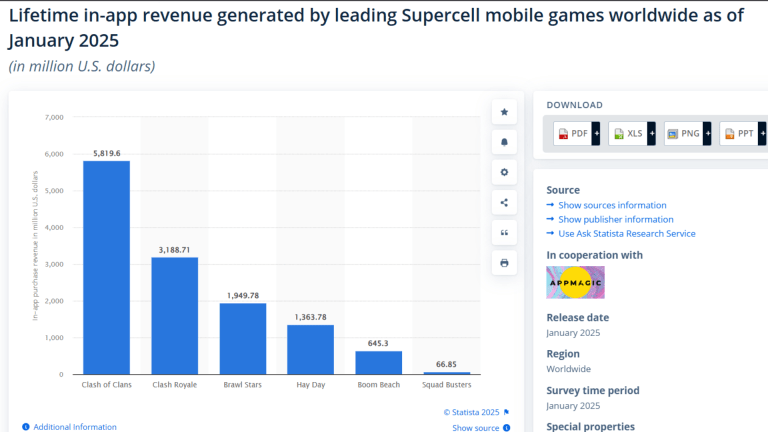
So far this year, the company generated 206.8 million downloads and $1.08 billion in revenue, with nearly 85% coming from just three titles: Clash of Clans, Clash Royale, and Brawl Stars. This isn’t portfolio sprawl — it’s focus at extreme scale.
Each flagship plays a different role:
Clash of Clans leads in daily and monthly active users
Clash Royale remains the strongest monetizer
Brawl Stars combines scale with fast live-ops iteration
Newer games like Squad Busters and mo.co are clearly being treated differently. They’re driving installs, but not revenue — a strong signal that Supercell is choosing incubation over forced monetization.
Zooming out further, the long-term trend is even clearer. Downloads have gradually declined since the mid-2010s, yet revenue has remained stable, with spikes driven by live-ops evolution, not new launches. Supercell isn’t chasing raw growth anymore. It’s optimizing for player lifetime value, operational durability, and execution quality.
Live Games Become the Company’s Core
The most meaningful structural change is the consolidation of Business Operations, Marketing & Community, People, and Game Tech into a single Live Games unit.
This matters because modern mobile hits aren’t products anymore — they’re long-term services. Once a game reaches scale, live ops complexity explodes: content cadence, monetization balance, tooling, player communication, and technical infrastructure all need to move in sync.
Supercell’s answer isn’t tighter control over teams. It’s tighter alignment around them.
A New Role, Not a New Direction
To lead the Live Games unit, Supercell appointed Sara Bach as President of Live Games. This isn’t a symbolic title. It’s a functional one.
Her role is to own the day-to-day operational complexity so teams can stay focused on what matters most: the player experience. According to Supercell’s leadership, her strength lies in navigating scaled organizations while staying aligned with the company’s culture — a rare but critical balance at this stage.
Founder Energy Shifts Upstream
With live games operational leadership in place, Ilkka Paananen is shifting attention toward vision, culture, and new games.
Alongside Drussila Hollanda, Head of New Games, the focus is on pushing a more entrepreneurial mindset upstream:
Less hierarchy
More founder energy
Faster experimentation
In effect, Supercell is separating concerns: stability and excellence for live games, startup-like chaos for new ones.
Why This Matters Beyond Supercell
This isn’t just a company update — it’s a blueprint for where top mobile studios are heading:
Live ops is no longer a support layer; it is the business
Organizational complexity must increase without killing speed
Founder-style autonomy scales better than command-and-control
Culture becomes a competitive advantage, not a slogan
Supercell isn’t reinventing itself. It’s tightening the system that already works — preparing it to survive another decade of live operations at global scale.
For anyone building or operating live games, this shift is less about inspiration and more about inevitability.