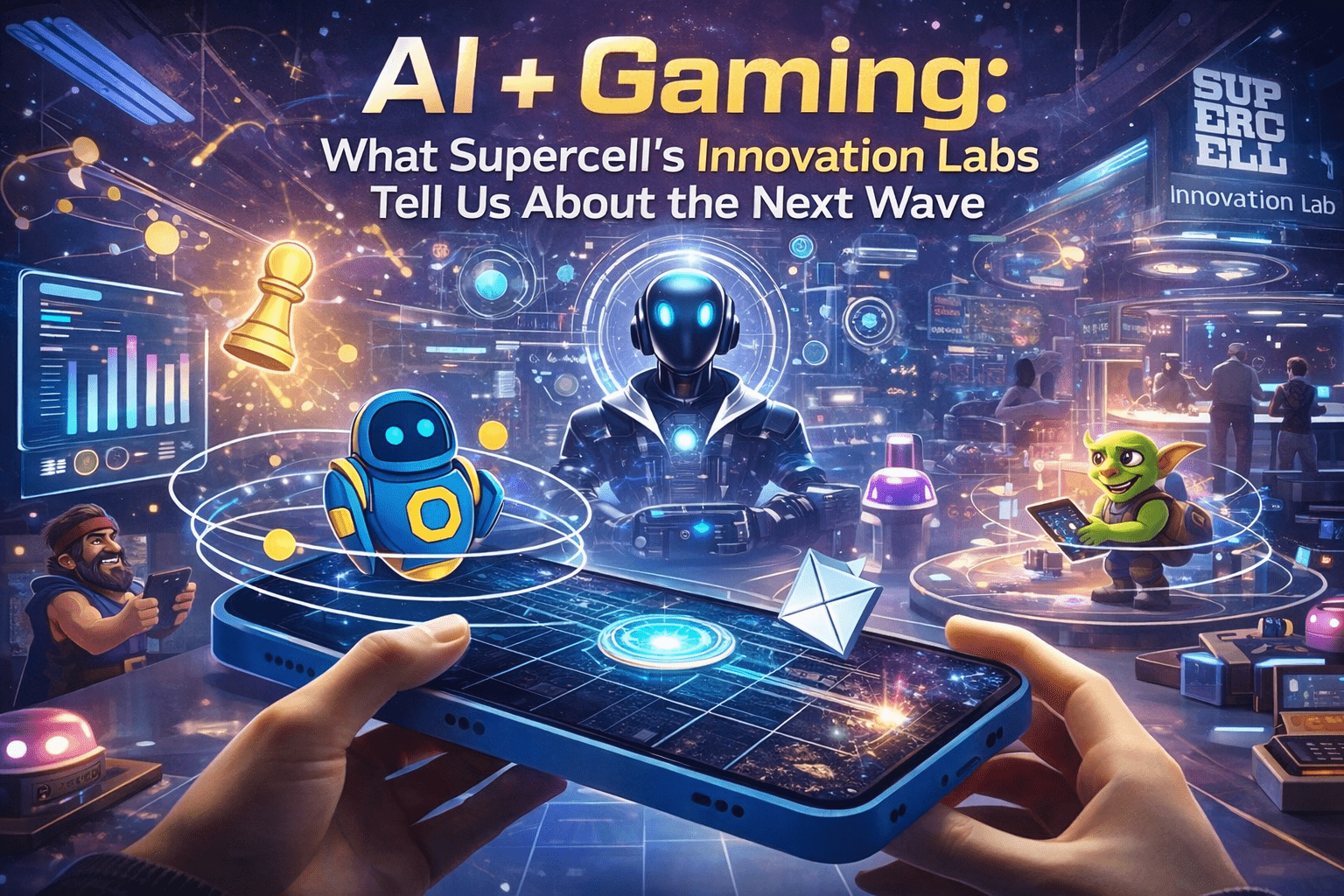
Supercell’s 2025 report contains a quiet but significant signal about where the company thinks the future of gaming is heading. Buried between the Clash Royale comeback story and the Squad Busters post-mortem is a paragraph about their AI Innovation Lab — and the scale of what they’re now running deserves more attention than it’s getting.
What started as a Helsinki pilot last spring expanded to San Francisco in the fall. This April, Supercell is running three simultaneous cohorts: Helsinki, San Francisco, and Tokyo. The focus, according to CEO Ilkka Paananen, is on founders exploring entirely novel gameplay experiences at the intersection of AI and gaming.
Why This Is Different From Most ‘AI in Gaming’ Announcements
Most gaming industry AI announcements in the past two years have been about production efficiency — AI-assisted art generation, automated QA, NPC dialogue systems. That’s real and useful, but it’s not what Supercell’s lab is focused on.
The framing in the annual letter is explicitly about novel gameplay experiences — the kind of innovation that brings new players to mobile in the way Clash Royale and Pokémon GO did in 2016. The implication is that Supercell believes AI isn’t just a tool for making existing games cheaper to build. They think it could enable categories of games that simply aren’t possible without it.
The Startup-Within-A-Company Model Applied to AI
The AI lab runs on the same structural principles Supercell is now applying across all new game development — tight teams, real constraints, aligned incentives, and founders with genuine equity-style upside if their projects succeed. Several teams from previous lab cohorts have continued working with Supercell after their cohorts ended, suggesting some are building toward actual products, not just experiments.
Running three concurrent cohorts across three different cities also signals something about pace. Supercell isn’t approaching this methodically and cautiously. They’re running parallel bets, accepting that most won’t lead anywhere, and optimizing for finding the one or two ideas that genuinely could change something.
What AI-Native Games Might Actually Look Like
This is still speculative territory — Supercell hasn’t disclosed what specific projects the labs are working on. But some directions seem plausible based on where the technology and the industry intersect: games where the narrative adapts dynamically to individual player choices in ways that hand-scripted content can’t; opponents and NPCs that learn and evolve based on player behavior rather than fixed programming; procedural world-building that creates genuinely unique environments at a scale humans couldn’t design manually; or social experiences that use AI to match players in ways that feel meaningfully different from algorithmic ranking systems.
Any of these could represent the kind of ‘I’ve never seen anything like this’ moment that Supercell — and the broader industry — has been looking for.
The Bigger Context
Supercell is doubling its new game investment year over year, and the AI lab is a meaningful part of that. Paananen is explicit that optimization alone won’t grow the mobile market. The industry needs new players, and new players require experiences that don’t exist yet.
Whether AI is the vector that produces those experiences remains to be seen. But the fact that one of the most financially successful mobile studios in history is running three-city parallel innovation labs specifically focused on AI-native gameplay — and doing it quietly, without a press event or product announcement — suggests they believe the stakes are real.
The next wave in mobile gaming might be built on AI. And the teams most likely to catch it are the ones already in the water.