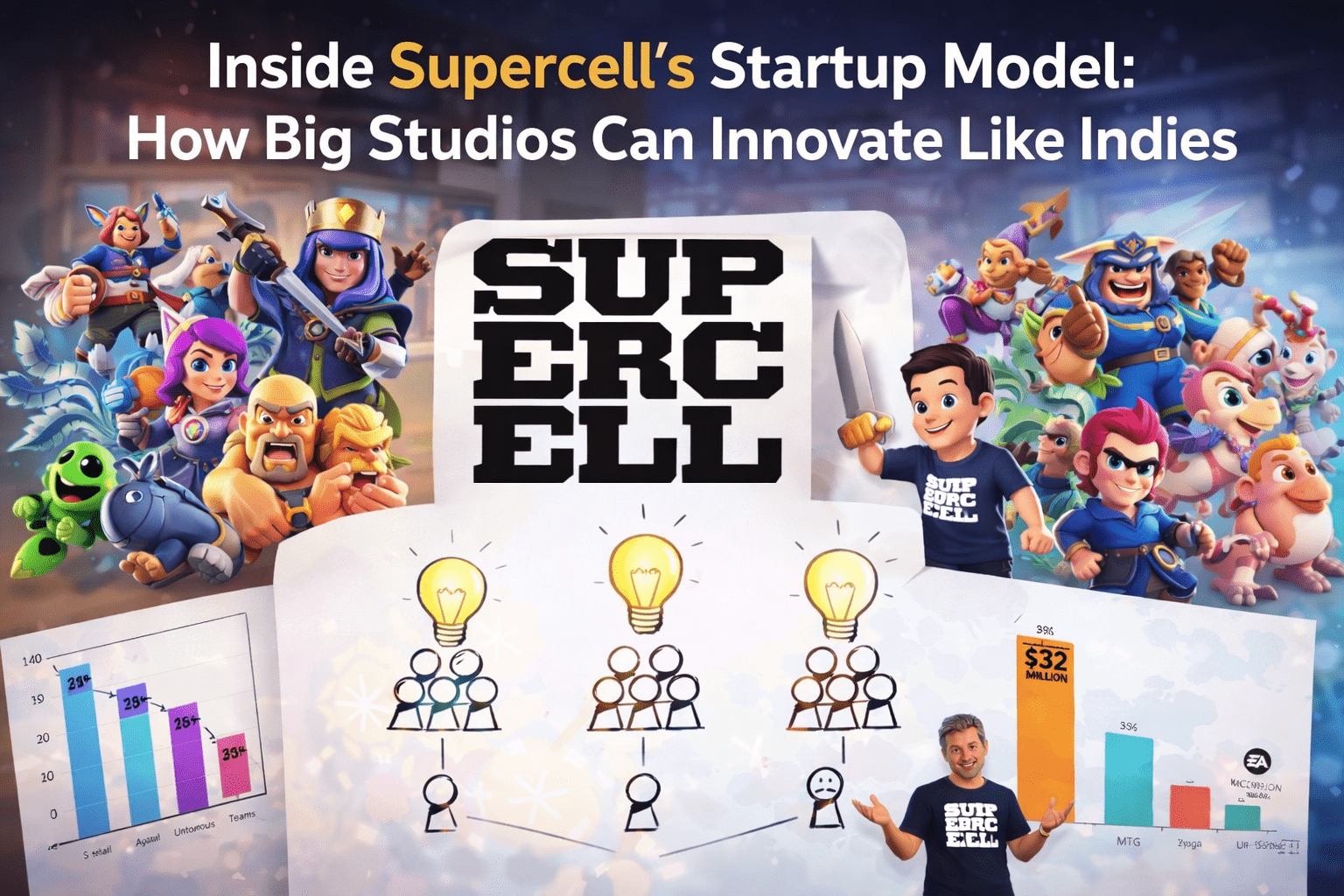
Supercell just revealed a major internal restructuring in their 2025 annual report — and it’s not about org charts or headcount targets. It’s about solving a problem that nearly every large game studio eventually faces: how do you stay innovative when you’re no longer hungry?
CEO Ilkka Paananen is unusually direct about where the company went wrong. For over two years, he’d been talking about new game teams operating like startups. But as he now admits, they only went partway there. They hired entrepreneurial people and gave them independence — but they didn’t create the structural conditions that make startups actually work. That, he says, was his failure to fix.
Two Separate Organizations, Two Separate Cultures
The first big move was structural. Supercell has now split live game operations and new game development into genuinely separate organizations — different spaces, different cultures, different ways of working. Sara Bach now leads everything on the live games side. Drussila Hollanda, brought on in mid-2025, runs all new game development.
The logic is clean: live game teams need to stay focused on serving players who are already there. New game teams need to stay focused on inventing things that don’t exist yet. Mixing those two missions under one roof consistently produces mediocre results at both.
The Three Pillars of Supercell’s Startup Model
📌 Entrepreneurial founders, not game concepts
Supercell says they greenlight teams, not ideas. The reasoning: you can’t predict which concept will work. But you can identify people who have the drive and vision to keep iterating until they find something that does. For a company of nearly 900 people, that’s a fundamental shift in how decisions get made.
📌 Real constraints, not theoretical ones
New game teams now operate with actual budget-based constraints. Paananen makes a point that sounds counterintuitive but holds up: teams with unlimited resources rarely make the best products. Constraints force prioritization, clever problem-solving, and urgency. Without them, teams explore endlessly without producing breakthroughs.
📌 Aligned incentives for startup-level risk
This is perhaps the most significant structural change. New game teams at Supercell now participate in the profits of a game if it successfully launches. The goal is to make Supercell a viable option for people who might otherwise go and start their own studio. The upside has to match the risk being asked of them.
What Supercell Still Brings That Startups Can’t
All of that startup thinking gets layered on top of something no actual startup has: 300 million monthly active players, tens of thousands of creators in their network, direct relationships with Apple and Google, and a marketing and live ops machine that has successfully scaled multiple global hits.
Paananen uses the analogy plainly: you build the rocket ship, Supercell provides the launchpad. Squad Busters, for all its problems, proved the launchpad works — 40 million pre-registrations, 75 million downloads. The rocket just didn’t reach orbit.
For large studios elsewhere trying to figure out how to compete with nimble indie teams, Supercell’s model is worth studying carefully. The answer isn’t to imitate startups superficially. It’s to actually build the conditions — structural, cultural, financial — that make them work.