🚨 Unity shares all-time low near $18.36
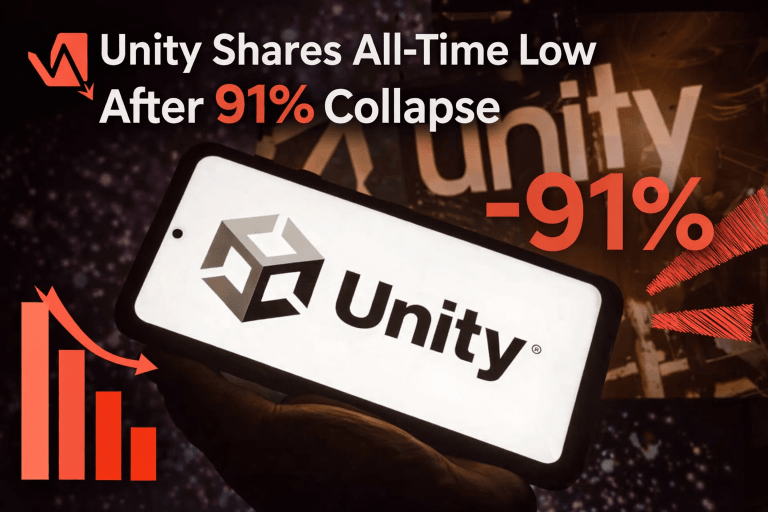
Unity shares all-time low levels are now in sight after the company’s stock closed at $18.36 on February 17th, 2026, marking one of its weakest performances since going public.
The latest drop places Unity shares close to their summer 2024 record-low range of $15–$17.
The current price reflects:
📉 59% decline since January 2nd, 2026 ($44.25)
📉 16% year-over-year decline
📉 91% fall from its November 18th, 2021 peak of $201.12
The magnitude of the Unity shares all-time low situation highlights prolonged investor skepticism around the company’s recovery strategy.
📊 What’s Driving the Unity Shares All-Time Low?
Several long-term and short-term factors have contributed to Unity shares all-time low territory.
🔥 Historical Issues
The controversial Runtime Fee announcement
Company-wide restructuring
The 2022 IronSource acquisition
Unity initially projected the IronSource merger would make the company “highly profitable,” but sustained profitability has yet to materialize.
🤖 New Competitive Pressure
More recently, investor concerns escalated following the US rollout of Google’s Project Genie on January 29th, 2026.
Project Genie allows users to generate interactive virtual worlds using text prompts, offering short playable experiences powered by AI.
Although Unity CEO Matthew Bromberg described Google’s tech as “a powerful accelerator,” markets reacted cautiously. Shares across game-world creation platforms — including Roblox and Unity — declined sharply following the announcement.
📉 Eight-Day Slide and Earnings Reaction
Unity shares all-time low territory followed:
📆 Eight consecutive days of decline
📈 A brief recovery to $29.06 on February 10th
📉 A renewed drop after Q4 earnings release
On February 11th, Unity reported Q4 results that exceeded guidance expectations:
Despite beating revenue guidance, shares fell again following the earnings announcement.
📅 Full-Year Financial Snapshot
For the full year 2025:
While the losses are narrowing, Unity shares all-time low pricing suggests investors remain unconvinced about long-term profitability and competitive positioning.
🧠 Unity’s AI Strategy Moving Forward
In its latest investor call, Bromberg announced plans to launch a beta version of an upgraded Unity AI tool.
The company claims the tool will:
Enable developers to prompt full casual games into existence
Use natural language to generate playable content
Accelerate development workflows
Unity appears to be leaning into AI-native tooling as both a defensive and offensive strategy against competitors like Google.
🎯 Why This Matters
Unity shares all-time low levels reflect broader structural concerns:
Slower revenue growth compared to expectations
Heavy competition in AI-assisted game creation
Lingering trust issues from past pricing controversies
Ongoing profitability challenges
Even as revenue stabilizes and losses narrow, market confidence remains fragile.
🔎 Final Take
Unity shares all-time low pricing marks a dramatic reversal from the company’s 2021 valuation peak.
A 91% decline in under five years is not just a correction — it signals deep investor concern about future growth and defensibility in an AI-driven ecosystem.
The next critical test will be whether Unity’s new AI tools can reignite developer confidence and restore shareholder trust.
For now, the market remains cautious. 📉