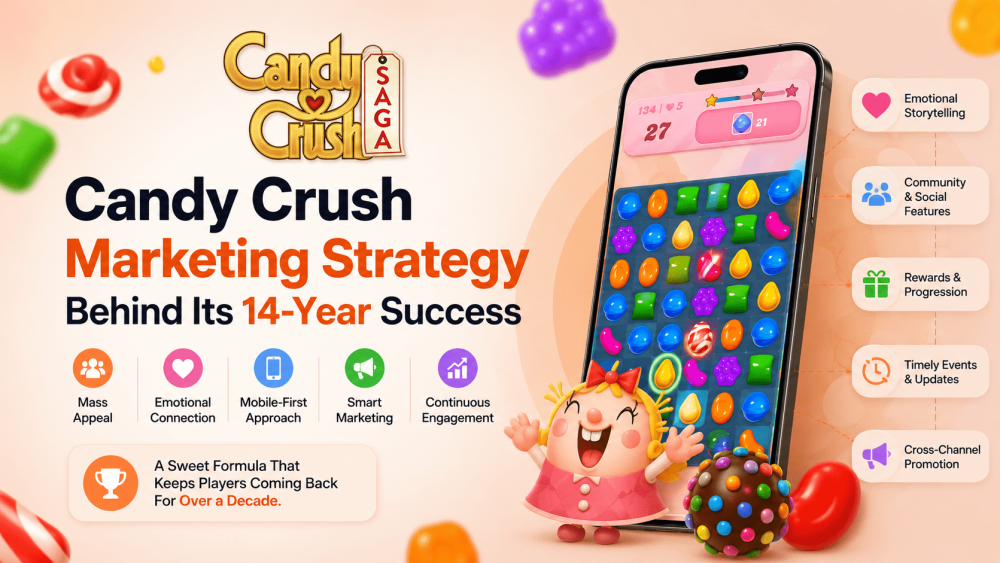
The Candy Crush marketing strategy continues evolving even after 14 years, helping the franchise remain one of the highest-grossing mobile gaming brands in the world.
Developed by King, the original Candy Crush Saga has generated more than $20 billion in lifetime revenue while maintaining global recognition across generations of players.
Rather than slowing down, King continues investing heavily in creative campaigns, social content, IRL activations, and performance marketing to keep the franchise culturally relevant.
Candy Crush marketing strategy uses multiple specialized teams
The scale of the Candy Crush marketing strategy requires collaboration across multiple departments at King.
These include:
- Performance marketing
- Product marketing
- Brand marketing
- CRM teams
- Social media
- PR
- Marketing Studio creative teams
According to Sian Finnis, the company focuses on connecting every player touchpoint both inside and outside the game.
This allows campaigns to feel consistent across:
- Mobile ads
- Social media
- Live-service events
- Real-world activations
Different platforms require different content strategies
One of the key pillars of the Candy Crush marketing strategy is platform-specific content.
King tailors campaigns based on audience behaviour:
📱 Instagram
- Memes
- Short-form edits
- Humorous content
📘 Facebook
- Mini puzzles
- Interactive engagement posts
▶️ YouTube
- Behind-the-scenes developer content
- Long-form storytelling series
King has also experimented with:
- ASMR candy videos
- Claymation-style content
- “Where’s Wally?”-inspired interactive videos
These approaches help Candy Crush stay visible even when players are not actively gaming.
Performance marketing remains central
Despite being one of mobile gaming’s most recognizable brands, the Candy Crush marketing strategy still prioritizes aggressive user acquisition.
King describes performance marketing as a battle for attention inside fast-scrolling feeds where ads are unavoidable. Gameplay remains the centerpiece of these campaigns.
According to Sian Finnis:
“Gameplay absolutely is king for performance marketing.”
The company focuses heavily on:
- High-energy gameplay footage
- Fast-paced edits
- Visually satisfying moments
- Immediate player hooks
Candy Crush treats live-service seasons like game launches
A major reason the Candy Crush marketing strategy remains effective is its live-service approach.
Candy Crush regularly launches themed “tentpole” seasons designed almost like entirely new game releases.
Roberto Kusabbi explained that major seasons such as:
receive full launch-style marketing treatment.
These campaigns include:
- New visual identities
- Competitive branding
- Updated logos
- Event-focused storytelling
For the 2026 All Stars event, King leaned heavily into:
- American sports visuals
- Esports aesthetics
- Bold typography
- Collectible-card inspiration
Candy Crush marketing strategy expands into IRL experiences
King has increasingly pushed the Candy Crush marketing strategy beyond digital channels.
Recent real-world campaigns included:
- Giant candy jar activations in Chicago
- Candy Crush takeovers at California’s Intuit Dome
- Interactive public experiences
These experiments aim to strengthen player engagement and transform Candy Crush into a broader entertainment brand.
AI experimentation is part of the creative workflow
King also confirmed that AI tools are being explored within the Candy Crush marketing strategy.
Rather than replacing creative teams, AI is treated as:
- A supporting tool
- An ideation accelerator
- Part of the broader production toolbox
The company emphasizes that human creativity still drives campaign direction and execution.
Why Candy Crush still advertises after 14 years
Even after more than a decade of success, King believes marketing remains essential because:
- Many users have not played in years
- The game continues evolving
- New features constantly launch
- Younger audiences discover the IP for the first time
The company sees Candy Crush as both:
- A legacy gaming brand
- An evolving live-service platform
This mindset helps explain why the Candy Crush marketing strategy remains so aggressive and experimental.
Final thoughts
The Candy Crush marketing strategy shows how mobile gaming brands can remain culturally relevant long after launch.
By combining:
- Platform-specific social content
- Performance marketing
- Live-service storytelling
- IRL activations
- AI-assisted experimentation
King continues transforming Candy Crush from a mobile game into a long-term entertainment ecosystem.
Few mobile games survive for 14 years at the top of the charts. Candy Crush continues proving that strong marketing, constant iteration, and cultural adaptability are just as important as gameplay itself. 🚀